Enterprise AI – Enablers for the next wave of infrastructure cloud

The acquisitions of MosaicML and Neeva by Databricks and Snowflake prompted this blog. Some definitions and then lets zoom out..

Consumer AI: heypi.com, ChatGPT and Bard are consumer AI service

Enterprise AI: Any SaaS/SW product powered by neural nets that is addressing a workplace/B2B or B2C use case. e.g. Jasper.ai, Databricks, Snowflake.

We all have seen and heard about this.

From Nov’22 to now Aug’23 – in one human pregnancy cycle (9 months), technology companies have given birth to their new child(ren) – ChatGPT, Bard, LLaMa-1,2, Dolly and many more LLMs (open & closed models with the recent announcement of Inflection (www.heypi.com) raising $1.3B, the consumer AI is in full swing. Combined they have raised >$10B.

Reflecting back to the 2000s, the consumer use cases emerged first, followed by enterprise. Search (Google), e-commerce (Amazon), and social media (Yahoo, MySpace) were the precursors to the rise of enterprise SaaS (CRM via Salesforce as the initial one). While Salesforce (founded in February 1999) was a cloud-first company, the “SaaSification” or “cloudification” of enterprises did not happen until AWS S3 and EC2 were announced in 2007 — almost 8 years later. To be clear Salesforce was not a cloud-native or cloud-resident SaaS until the past few years. It had SaaS as a business model from day 1. To get some data on Enterprise vs Consumer, I turned to our new Oracles…ChatGPT and Bard.

I asked ChatGPT & Bard the following prompts. ChatGPT failed, but bard came through..

  1. What is the total accumulated revenue for consumer SaaS?
  2. What is the total accumulate revenue for enterprise SaaS? (it gave market TAM instead)
  3. What is the total VC investments in consumer SaaS between 2003 and 2022?
  4. What is total COGS for consumer SAAS companies between 2003 and 2022?
  5. What is the total COGS for enterprise SaaS companies between 2003 and 2022?
  6. What is the accumulated revenue of AWS, GCP and Azure between 2007 and 2022?
  7. Can you now summarize the above data – into Enterprise SaaS and Consumer SaaS by revenue, COGS and investments between 2003 and 20022 in a simple table? – It put then summary in Google sheets.
MetricEnterprise SaaSConsumer SaaSSource Data
Market TAM (2021)$128.5 billion$113.1 billionGartner
COGS (2003-2022)$483.1 billion$359.3 billionStatistia
VC investments (2003-2022)$330.3 billion$243.8 billionPitchbook
Top 5 companies by revenue (2022)Salesforce, Workday, ServiceNow, Adobe, MicrosoftZoom, Slack, Atlassian, Adobe, Microsoft
Top 5 companies by COGS (2022)Salesforce, Workday, ServiceNow, Adobe, MicrosoftZoom, Slack, Atlassian, Adobe, Microsoft
Top 5 companies by VC investments (2022)Salesforce, Workday, ServiceNow, Adobe, MicrosoftZoom, Slack, Atlassian, Adobe, Microsoft
Source Bard: Consumer vs Enterprise SaaS
Cloud PlatformAccumulated Revenue (2007-2022)
AWS$900 billion
Azure$350 billion
GCP$150 billion
Source Bard: Accumulated Revenue – $1.4T

A few observations with this high level perhaps inconsistent sources of data.

  1. A significant portion of the $800B in COGSs was funded by Venture investments (spurious correlation – the total VC investments is also close to $570B).
  2. While the data here shows enterprise SaaS is bigger than consumer SaaS, if you include FB, GOOG, AWS – consumer SaaS is a lot bigger but also lot more concentrated vs enterprise SaaS where there are 150+ public companies and perhaps hundreds of startups.
  3. AWS was the biggest beneficiary of both the VC investment dollars and the open source community (AWS resold open source compute cycle for many years)
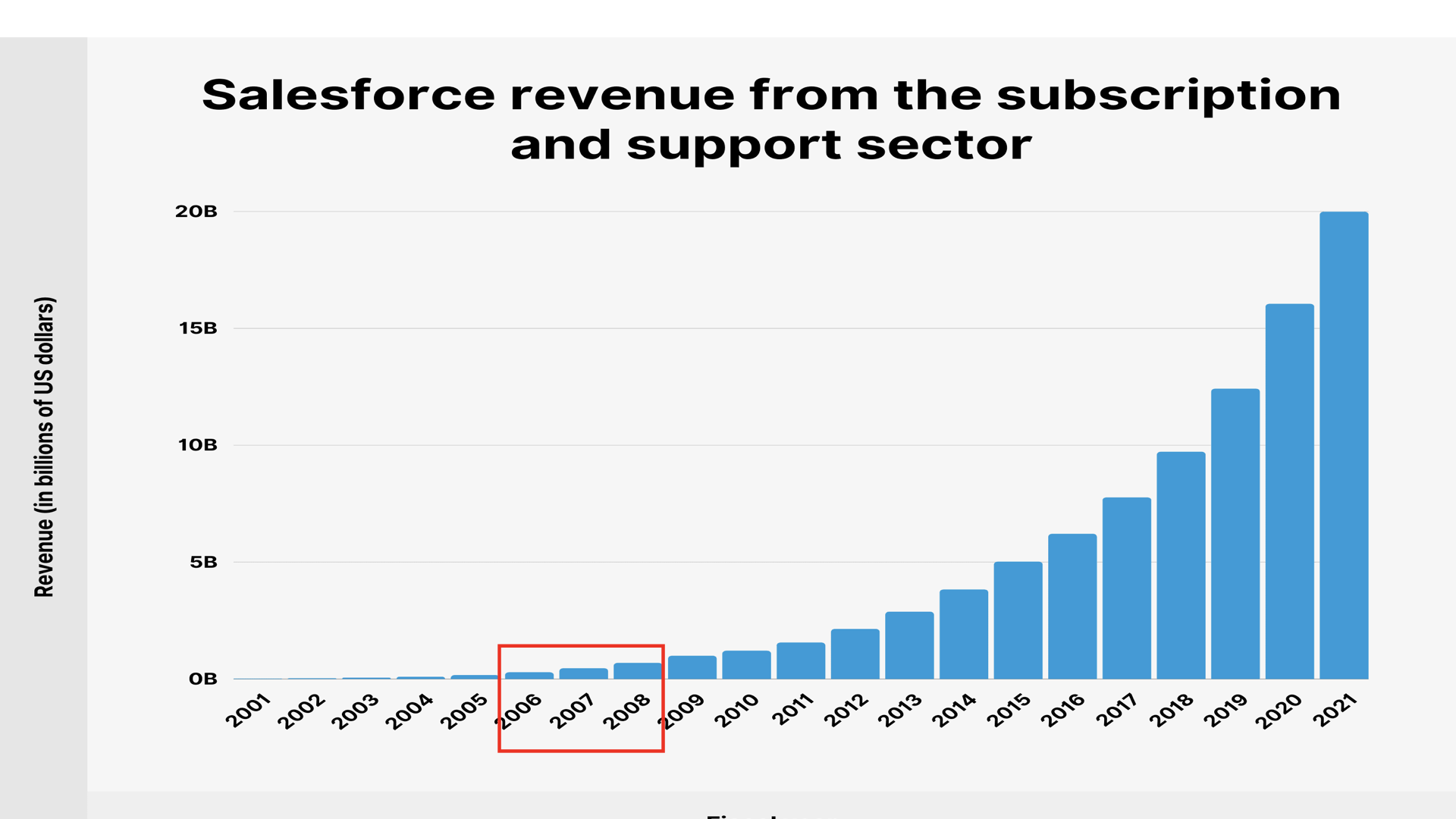
  4. Salesforce (CRM) was early with enterprise SaaS in 1999 along with Google and Amazon (consumer SaaS), the enterprise SaaS business inflection happened around circa 2007 i.e. the knee of the curve was 2007 – a 7-8 year lag behind consumer SaaS. (Salesforce revenue as a proxy).
A significant portion of the $800B of VC investments were funding CACC (Cost of Customer Acquisition). While I don’t have the actual percentage spent on CACC, but I would hazard a guess it would have been >30% maybe as high as 50% for many companies.

Assuming conservative 20%, that is $100B of venture capital going into CACC. And perhaps >$500B of cloud spend (COGS) with AWS, GCP and Azure during the same years. The total revenue of AWS, GCP and Azure between 2007 and 2022 is $1.4 trillion.

Hindsight is 20/20 – but projecting forward consumer AI and enterprise AI are going to be bigger – but the big shift is now from cost of customer acquisition (CACC) to Cost. of Compute (CoC) and the time collapse between Consumer AI and Enterprise AI. Lets look at both perhaps speculate or project forward.

  1. Cost of Compute (CoC)

A significant portion of VC and Corporate investments in the past 9 months is for cost of compute for largely consumer AI companies. The winner (to-date) in this round is Nvidia like SUNW was in the last round until 2003. Back in 2001, Internet was run by Sun boxes until the Open source, Linux and distributed systems became the new infrastructure stack.

As Elad Gil points out on twitter “At this point LPs in venture funds should just wire money direct to NVIDIA & skip the LP->VC->Startup->NVIDIA step”. Not so fast – the fish was falling into the boat back in 2001 at Sun and soon after it had to go fishing. More on this later.

And then there is Martin’s tweet – “If a company is going to train a $5B model, wouldn’t it make sense to use 5% of that to build a custom ASIC for that model? The benefits are certain to dwarf the 5% investment. At these scales, even ASIC design costs become marginal“. 5%. of $10B – enough for a new systems company to be built either from within the traitorous 8 or via a VC / Corporate investment. (more on this in a future blog).

The wake of the SaaS tsunami (since 2001) left us with AWS as the winner and leaving behind big SMP OEMs like SUNW, SGI, DEC, IBM). 20 years later the traditional Enterprise is served by 3 OEMs (CSCO, Dell, HPE) and 2+ enterprise software companies (Oracle, SAP and a distant third in IBM). Now they (the traditional enterprise infrastructure companies – both hardware and software) face a new tsunami with AI. A multi-trillion COGS spend is ahead of us and as we see new cloud investments (Coreweave, LambdaLabs) as well as AI+SaaS companies (the list above), potentially becoming the new AWS or GCP as they grow. Nvidia is spreading its new found shareholder capital to blanket this space. The silicon guys have woken up as they control the other end of the IP/value chain in a cloud stack. Given $10B+ of venture and corporate $s have gone to spend CoC in the past 7 months, it makes sense to fund startups that addresses CoC and challenge the incumbents? Seems like time is now – AWS from a perception has gone from #1 to #3 player in AI compute overnight, with Nvidia and (and perhaps its compatriots) thinking of how to enter this space.

AI unlike the past two decades of SaaS wants to be everywhere. In the cloud, on-prem, in-between, edge etc etc.

2. Enterprise AI

It took 7 years between 2000 and 2007 and >$10+B investments to transform the Enterprise SaaS with a new set of players. Instead of 7 years, in 7 months, we move from Consumer AI to Enterprise AI at breakneck speed. With the acquisition of Neeva by Snowflake, and MosaicML by Databricks, the first set of rockets have been launched to take on traditional enterprise companies (SAP, Oracle, IBM).

Back in 2007, the winners for infrastructure were new cloud companies. This time the winners for new infrastructure is likely to include silicon players (e.g. Nvidia, Intel, AMD, AVGO) and potentially some losers. Unlike 2007, with AI, there is this issue of Data (sovereignty, privacy, security) and CoC. Enterprise SaaS (e.g. Salesforce) started with on-prem infrastructure but moved to the cloud eventually. But there is a real possibility of reverse migration (move closer to data) especially with AI. Snowflake is already positioning itself as the DATAI cloud.

What is becoming a possibility is for the first time in perhaps 40-50 years, the incumbent enterprise software infrastructure companies (SAP and Oracle) are going to be challenged by Databricks and Snowflake. I say respectively because SAP is to Databricks and Oracle if to Snowflake follow Jerry Chen’s framework ( systems of intelligence and systems of record ) and it applies here once more.
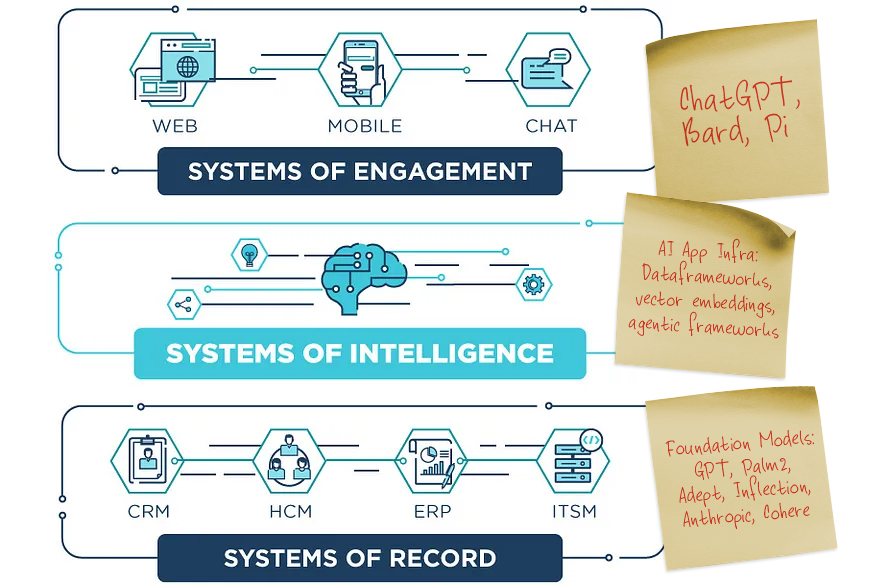
The systems of engagement are the new Chat Bots like ChatGPT and Bard. In the 1990s client server era – SAP took pole position in the App Tier (“Systems of Intelligence”) while Oracle powered the enterprises (“Systems of Record”) with Sun, HP and IBM being the infrastructure providers. I had a front row seat between 1991 and 2001 (Sun, SPARC etc) in both being enablers for SAP and Oracle via SMP platforms and built the multi-core/threaded processors to match with the emerging AppTier built with Java as the programming layer to take advantage of the thread parallelism from the silicon world.

With onset of AI, the agility and pace with which Databricks and Snowflake are Co-opting AI (both are in the cloud today) can challenge the traditional Enterprise duo (SAP and Oracle). While they both think they are competing, they are actually offering different value to the enterprises and over time they will overlap, but not today. The bigger opportunity for both is not to compete with each other but use the new tool in the quiver (“GenAI”) to upend SAP and Oracle with sheer velocity of execution, engagement value (SQL vs natural language. Both have to address data sovereignty if they want to take their fight to the SAP and Oracle world. Addressing that means like enterprise SaaS jumped to the cloud back in 2007, enterprise AI ha to extend from the cloud to be closer to the customer.

The success of Snowflake and Databricks despite competing and layering on top of current cloud infrastructure is proof point that they can compete against well capitalized and tooled companies (AWS – Redshift/EMR and Google – Spanner/BigQuery….) that if they chose to extend their offerings to on-prem enterprises , they can win if they can address the data problem i.e. they need to jump from current cloud to emerging new cloud offerings. They can enable and consume new infrastructure players who can solve or address the data proximity issue.

Given the scale of COGS spend in the cloud for $1.4 Trillion, there is a atleast a $1Trillion of spend ahead of us in Enterprise AI away from the big three (AWS, GCP, Azure) in the next 15 years potentially led by the new duo of Databricks and Snowflake. On-prem Enterprise AI – which will continue to thrive and could well seed the new infrastructure players.

Lets revisit this in 3 years if new infrastructure providers emerge addressing CoC in new and differentiated ways.

SoC to SoP

A reflection of moore’s law, personal history and coming Tsunami of Systems

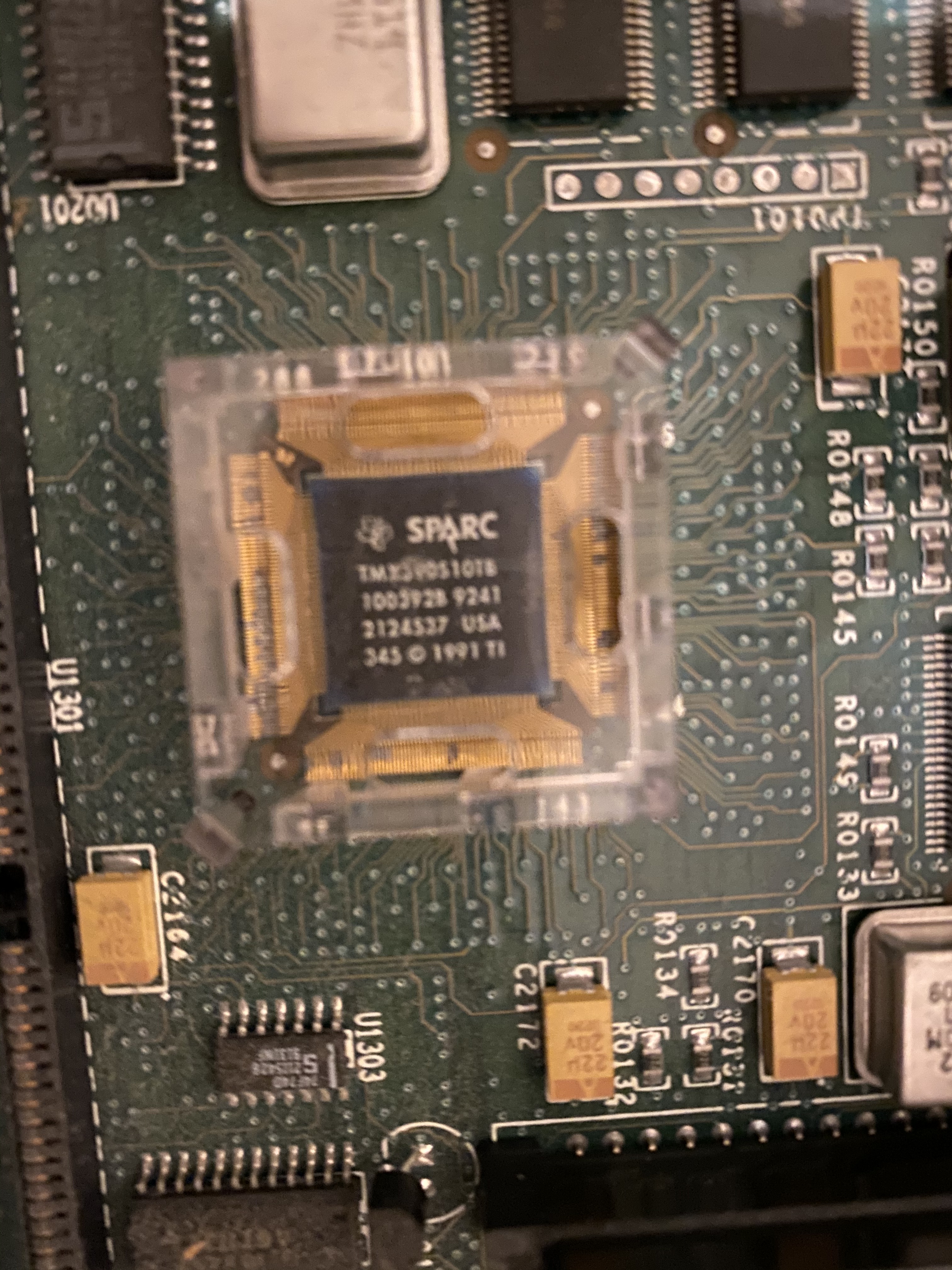
This blog was prompted by Pat Gelsinger in his recent keynote talking about Systems on Package (SOP). That brought memories of Systems on a Chip (SoC) – back to Circa 1991. While this term is common in the lingua franca of chip nerds these days, it was not the case back in 1991. Perhaps one of the first SoCs on the planet was one in which I was lucky to be involved with that also helped bootstrap my professional life in Silicon and Systems. It was Microsparc-I (aka Tsunami) while at Sun and that had a few firsts. All CMOS, first SoC and had a TAB package. All-in-one.

Image result from https://www.computerhistory.org/collections/catalog/102626774
MicroSPARC – 1 in a TAB package (Circa 1991)

This chip was in the system. Good to know its in the computer history museum archives.

Image
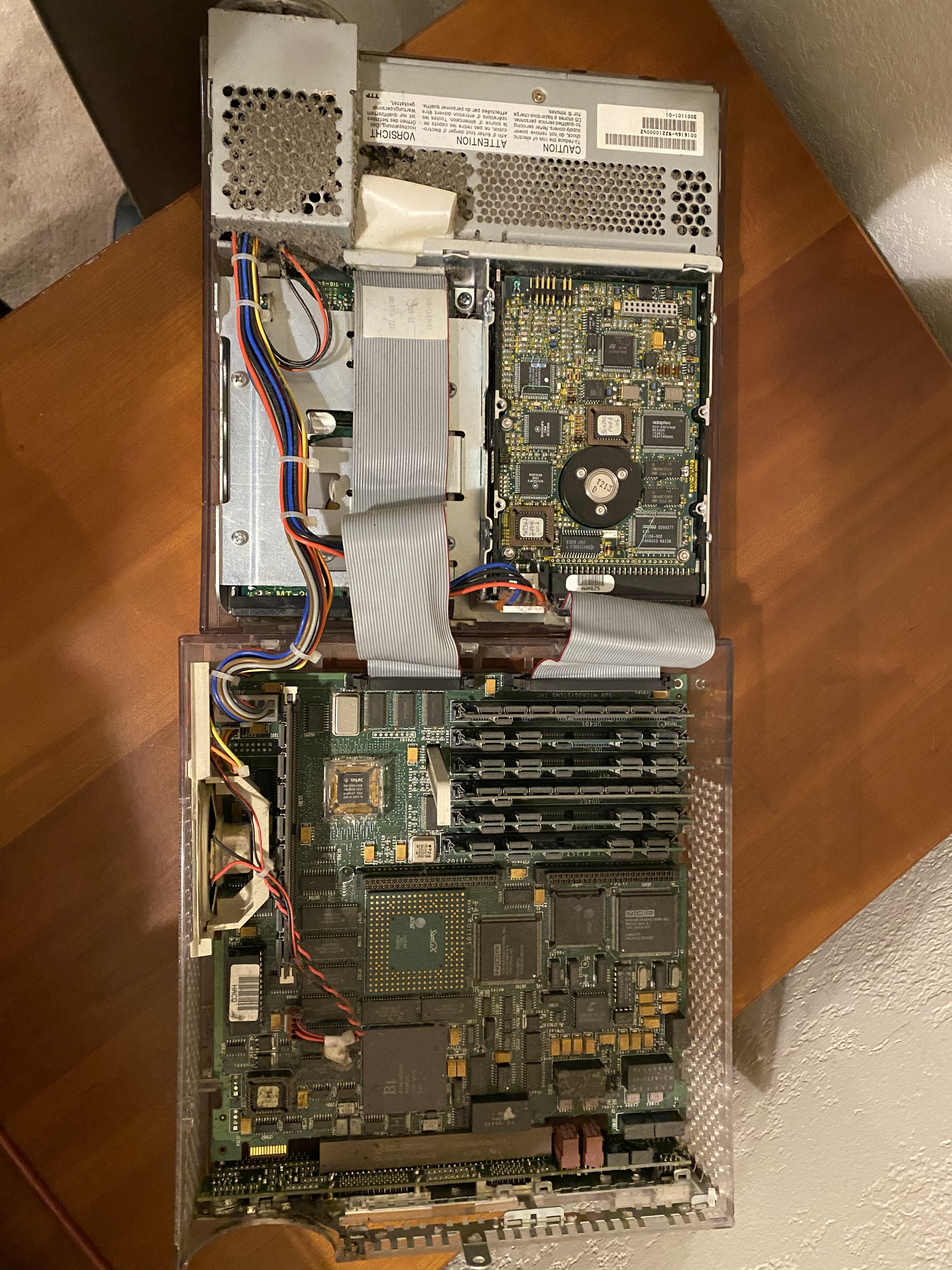
SparcStation

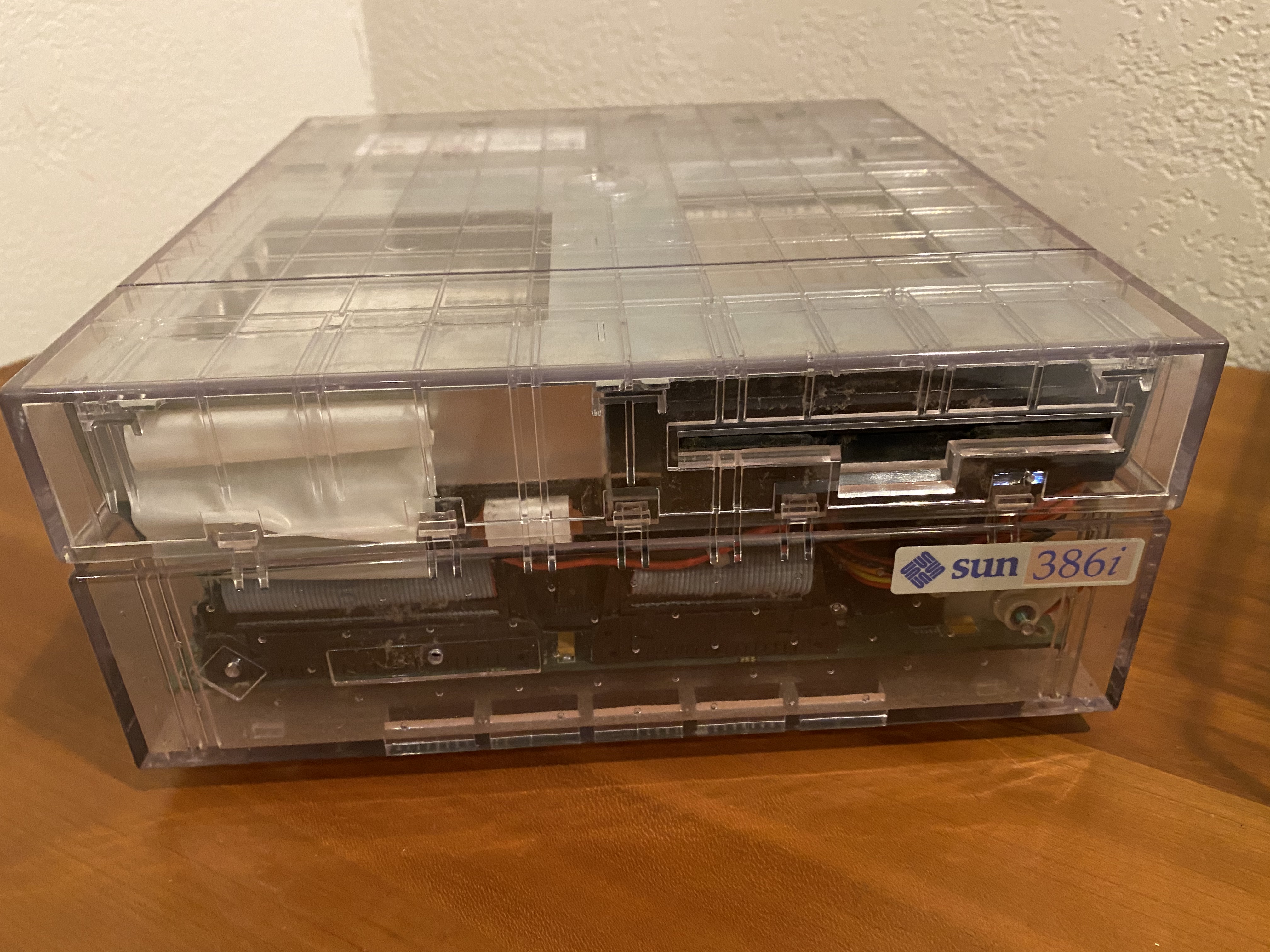
The label Sun 386i was a joke. Used to have Sun 386i platform and the joke was, this was faster and cheaper than any PC then.

Image
SparcStation
Image
MicroSPARC-1 on the board

That was the beginning of my semiconductor run in my professional life. It started with an ECL machine for SPARC we did back in 1987-1990, which got shelved eventually as it was going to be hard to manufacture and sustain volume production. Some of us without a job, were asked to work on a ‘low cost’ SPARC and work with TI on their 0.8uM CMOS process. While the rage then was BiCMOS (SuperSPARC for Sun) and Intel Pentium. It showed Intel despite being a tech and manufacturing power house, has made mistakes in the past, not just recently…We will come to that

The First SoC (Microprocessor SoC) had many firsts back in 1991.

  1. It was all CMOS (when BiCMOS and ECL were still ruling the roost
  2. It was all integrated (Integer Unit, Floating Point Unit, Icache, Dcache, MMU/TLBs, DRAM controller (SDRAM) and Sbus Controller (Pre PCI).
  3. It was in 0.8 uM CMOS (TI) and in a TAB package (as seen above)
  4. It was entirely Software driven tool chain – the physical layout was done with Mentor GDT tools – programmatically assemble the entire chip form basic standard cells and GDT P&R tools, Synopsys synthesis, Verilog. All SW driven Silicon – A first. There is a reference to it here. This led to the entire EDA industry rallying around the way Sun designed microprocessors and a whole sleuth of companies formed around that (Synopsys, Ambit, Pearl, CCT->Cadence and many many more).
  5. It was the beginning of the low cost workstation (and server) – approach $1000 and ‘fastest’ from a clock rage (MHz – when that was the primary performance driver in the early years).
  6. From 1991 through 2003 by the time I left Sun, was involved in 8 different generations/versions of SPARC chips and looking back, the Sun platform/Canvas not only helped me be part of the team that changed the microprocessor landscape, we changed the EDA industry and by late 1990s brought ODM manufacturing to traditional vertically integrated companies to completely outsource systems manufacturing.

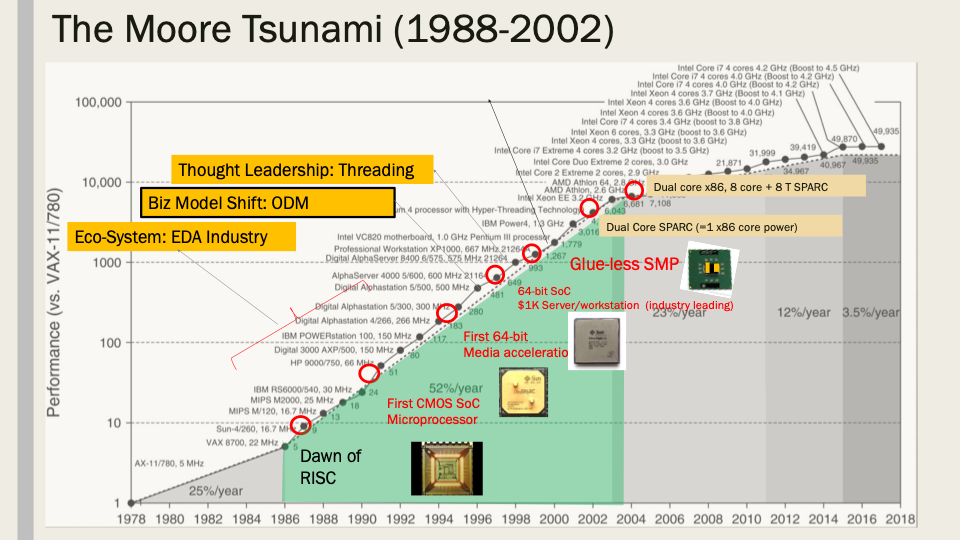
A visual of the height of Moore’s law growth and the success I rode with that Tsunami (Co-incidently the first chip for me was named Tsunami). From 0.8 uM 2LM CMOS to 0.65uM 10 LM CMOS. From 50 MHz to 2 GHz, 0.8M xtors to 500M xtors.

1991-1994 – Microsparc – The first CMOS SoC Microprocessor that extended Sun workstations and servers to the ‘low end’ and drove technology leadership with EDA companies named above in driving many ‘SW driven VLSI’. We built the chip with the following philosophy ‘construct by correction’ vs ‘correct by construction’ – which was the prevailing methodology. In modern parlance of Cloud – its DevOps vs ITops.

1995-1998 – UltraSPARC II and IIe – With the introduction of 64 bit computing, we continued to lead both on architectural performance (IPC), semiconductor technology (lead CMOS @ TI along with IBM until Intel took control of that by 1998), Clock Rate and many system level innovation (at Scale Symmetric Multi-processor, glue-less SMP at low cost, Media instructions). This was the Ultra family of compute infrastructure that was the backbone of the internet until the dot-com bust (2001-2003)!

1998-2001 – UltraSPARC I & E series: Created 2 product families and both drove new business ($1B+) for Sun. The Telco/Compact PCI business went form $0 to $1B in no time, the extension of workstations and servers to $1K and glue-less SMP (4-way) for <$20K, another industry first. The beginning of NUMA issues and pre-cursor to the dawn of the multi-core era. UltraSPARC IIi (codenamed Jalapeno) was the highest lifetime volume CPU for the entire lifetime of SPARC.

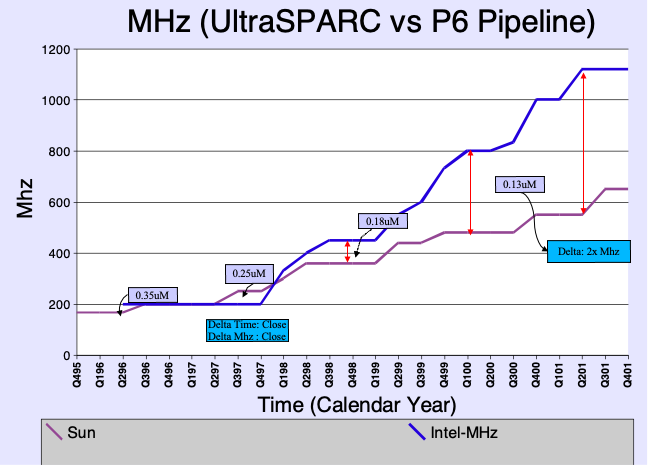
Clock Rate (SPARC vs x86)

While clock rate is not a good representation of actual device technology improvements, its the best first order relative metric I can share here given the dated history. Suffice it to say as you can see, until 1998 we had good technology (CMOS) FOM improvements per node until 0.18uM (Intel coppertone), when Intel decided to boost its performance by 60% when the industry average was 30%. That was the beginning of the end on two fronts – Sun + TI having enough capital and skills to keep up with the tech treadmill against Intel (althought we introduced copper for metal ahead of Intel) and the decision to start shifting architecture from pure IPC and clock to multi-core threading. Recognizing this, I started the multi-core effort around Circa 1998, but it took another 5 years to bear fruit. I digress.

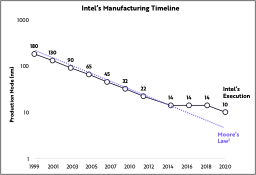
As a side note: Look at Intel technology improvement performance lately. I would never have in my wildest imaginations thought this would happen.

2001-2003 – Dawn of Multi-core and threading: While the results of these happened in 2001-2003, the seeds of this were sown in both multi-core in the form of dual core UltraSPARC IIe and eventually Niagara (UltraSPARC T Series).

The next 10 Year years is going to be as dramatic as the 1990s for completely different reasons at the system level. While Moore’s law has slowed down, the SoP is an important and critical technology shift to enable one to keep up the effective Moore curve. With Moore you got performance, power and cost at the same time./ We won’t get all three, but we can strive 2 out of 3 – i.e. Performance at constant cost or power.

SoP (Systems on Package) is an important milestone and glad to see Intel leading that and so is AMD and rest – but this can be a compelling way to construct the new system. In the next blog we will explore why the next 10 years is going be disruptive at the system level, but SoP like SoC and CMOS+Moore law was the Tsunami wave that raised a lot of boats including my career, many companies success and changed the industry and computing stack in a fundamental way.

I expect many firsts or changes or disruptions from design methodology to now customization by customer of various heterogenous silicon components (CPU, IPU, FPGA, memory elements and a lot more). Associated with that will be tools to assemble this, but also tools to make these look like one monolithic’ fungible computing element to the end user.

Virtualization to-date has been dominated by leveraging multi-core and improving utilization by spawning of many VMs that subdivide the machine into smaller chunks. New software layers either above or below the standard frameworks like Lambda (Server-less), PyTorch/TF (ML/AI) or Crypto will drive new ways to effectively use the dramatic increase in total silicon real estate including tiering of memory, scheduling code chunks to accelerators in coherent space (via CXL), new intra-rack and intra-node connectivity models via CXL and many more to come. Strap in for that ride/discussion. HW is getting more disaggregated from aggregation that started back in 1991 via SoC to now with SoP , Software will have to do the ‘aggregation’.

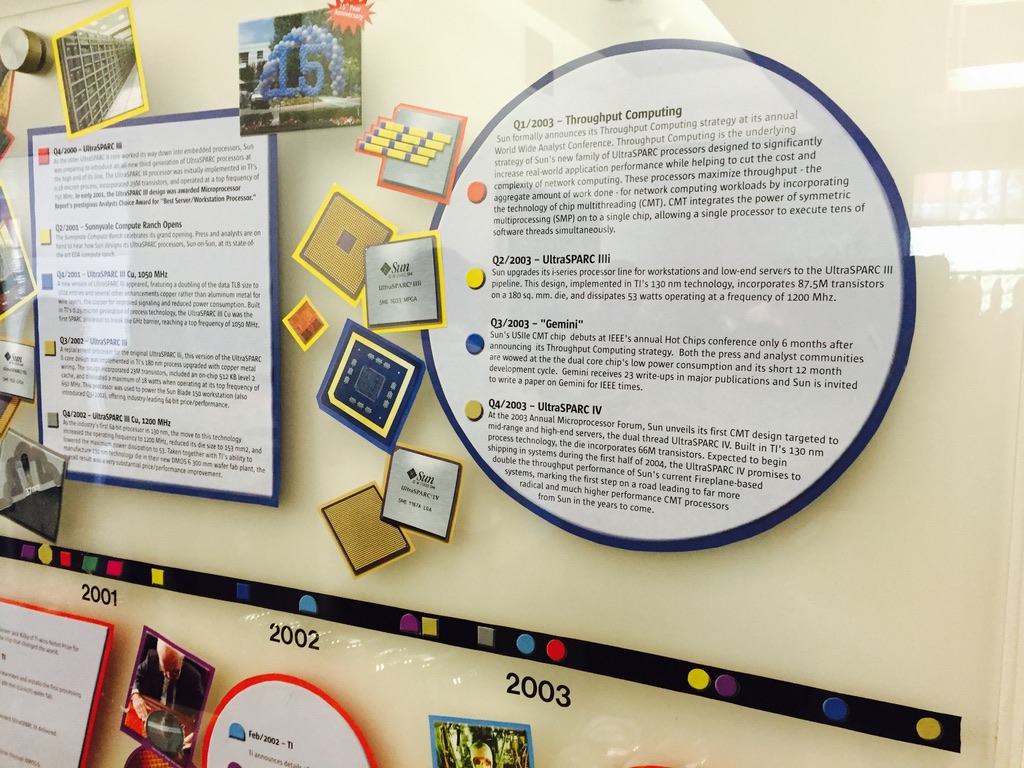
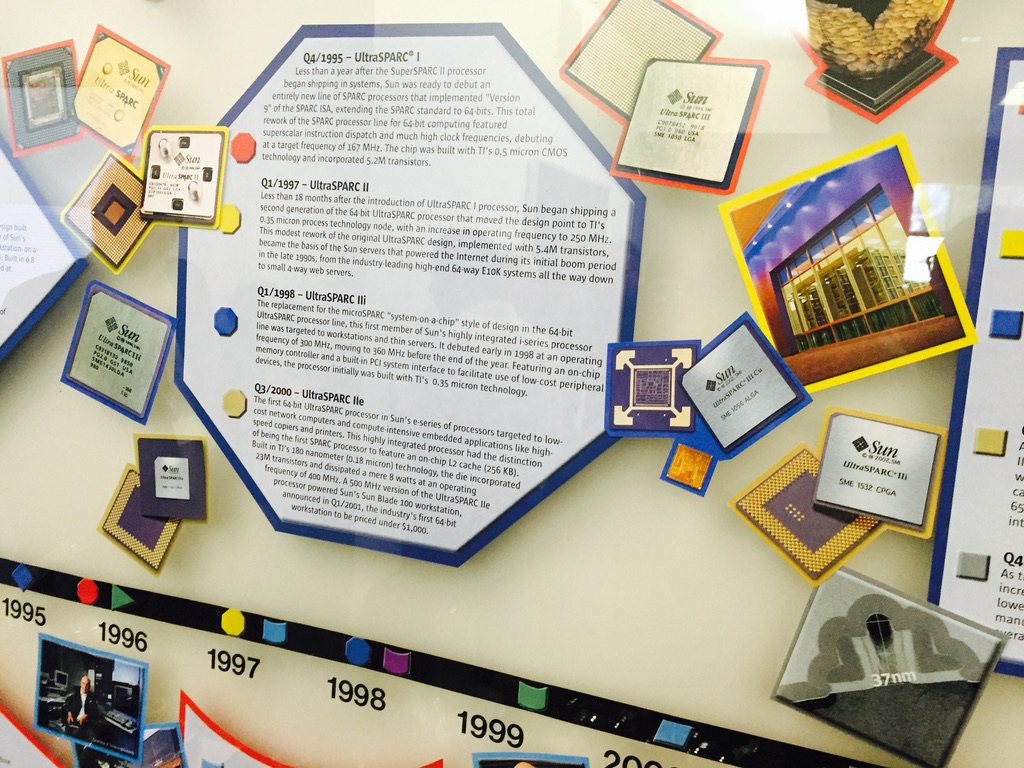
As I signoff, will share some more images from the 25 year anniversary of SPARC is captured here in this montage below.

$TSLA – Marching towards $10T by 2030……

First Trillionaire and 10 Trillion dollar company.

This is my 4th post on the topic of $TSLA and never thought I would do one in 2021. My predictions was a valuation of $1T by 2030. That will come and pass rather soon.

My first post on $TSLA was back in June, 2017 where the core value long term I thought was Chemistry (Battery) and Intelligence (Full Self Driving/Autonomy). That continues to be the case with Elon’s battery day (Sep’20) & Tesla Autonomy day on April 2019.

So why $10T? That seems to be even more ridiculous than the $1T. Since Feb’20 to now it has gone by 4x and $600B market cap. While there are lots of bears, there are lots of bulls as well for the TSLA case.

Bull Case #1: The bull case is presented by Ark Invest (Source: Ark Invest). Having crossed 500K in 2020 and total of 1M+ with 2 additional factories (Austin and Berlin) yet to come online, getting to 1-2M by 2025 is highly likely and approaching 5M might be difficult, but then Elon has beaten the odds and the market is expecting him to with the demand.

2020Example Bear Case 2025
Cars Sold (millions)0.55Example Bull Case

10
Average Selling Price (ASP)$50,000$45,000$36,000
Electric Vehicle Revenue (billions)$26$234$367
Insurance Revenue (billions)Not Disclosed$23$6
Human-Driven Ride-Hail Revenue (net, billions)$0$42$0
Autonomous Ride-Hail Revenue (net, billions)$0$0$327
Electric Vehicle Gross Margin (ex-credits)21%40%25%
Total Gross Margin21%43%50%
Total EBITDA Margin*14%31%30%
Enterprise Value/EBITDA1621418
Market Cap (billions)673$1,500$4,000
Share Price**$700$1,500$4,000
Free Cash Flow Yield0.4%5%4.2%
Ark Invest Projections

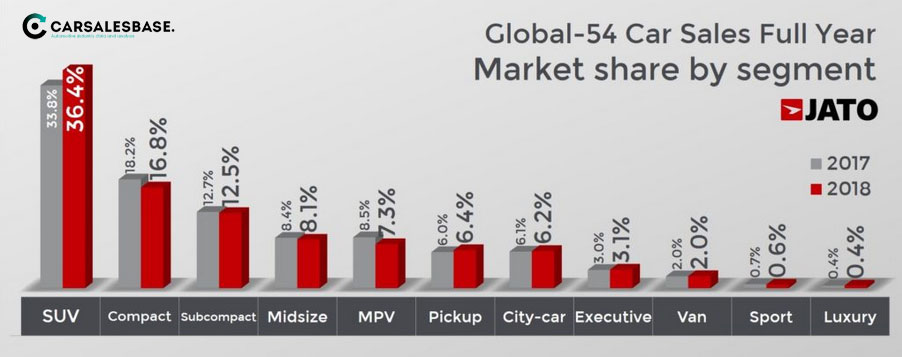
What’s interesting is TSLA has single-handely taken out the $35K- $100K market which the Germans dominate and Toyota tried hard to penetrate with incremental engineering and marketing. TSLA changed the game and will perhaps go as low as $25K but not lower is my guess. TSLA will license IP (Chemistry and Intelligence) and let others make the cars. The entire $35K to $100K is now ‘owned’ by TSLA and its going to be harder for most makers other than the BMW or Mercedes and they will be supported by ardent fans latched onto the brands. 2018 data for segmentation of the various categories is shown here.

2018-worldwide-car-sales-segments

Source: https://carsalesbase.com/global-car-sales-2018/

As you can see from above, 62.8% of the market will be covered by Tesla with Model 3, Model Y, Model S, Cybertruck and perhaps upcoming new China sourced $25K model. That includes the SUV, Midsize, MPV, Pickup, Executive, Sport and Luxury segments. The total market size is 54M cars and if Tesla can get 20% of that category – which actually is possible (we are in winner take all world these days with Amazon, Google, Apple where its tech driven) relative to conventional wisdom of highly fragmented and splintered market for automobiles.

Bull Case #2: Its what I mentioned in the last year. One has to look at TSLA as a business of businesses. Expect in the next 5 years, either take the Alphabet (GOOG) route or via other routes (Spin-offs, M&As, SPACs ….) derivative businesses will emerge and stand on their own. To re-cap

  1. A car company
  2. A Battery company at planet scale
  3. An AI/ML company (machine vision in particular)
  4. An electric storage company
  5. An Electric Utility company (low value but at scale gets interesting)
  6. An energy distribution company
  7. A potential Cloud or computer company (if a book store turns into cloud computing, an autonomous car can have the right assets for becoming a cloud company)
  8. A big data/mapping/navigation company
  9. A carless car company (i.e. Uber/Lyft killer robotaxi)
  10. A machine vision driven robotics company
  11. and more to come….(more than letters in the Alphabet)

Elon himself quoted a version of this back in Oct’2020

Bull Case #3: Chemistry and Intelligence. Every tech category goes through vertical integration and horizontal stratification. I speculate Elon will build down to a $25K car and below that, he will ‘license’ IP (Chemistry and Intelligence or battery tech and autonomy tech) to get worldwide reach. It would not make sense to have factories all over the world for all geos – but a strong IP revenue model ($1-$2K/car) could be had and also enable new players in countries to become car companies – i.e. more local manufacturing and distribution. And not just limited to cars, for all kinds of transportation and perhaps energy sectors. From the chart above the remaining 35% of the segments (Compact, Sub-Compact, City-car) would belong in this category. Of the 86M cars sold in 2018 (I suspect its less in 2021), 30M cars would be in this category. If 20% of the manufacturers pay TSLA $1K-$2K – lets assume $1K – that is $6B of pure profits which is subsidized by the higher end. The TSLA brand will be more valuable and trusted over VW, Mercedes, BMW, Toyota by 2025 that most people would buy a car ‘Tesla powered’. At this rate of battery cost decline (see blow), these manufacturers who cannot afford R&D or manufacturing at scale would do well to buy it off TSLA. This is akin to INTC holding onto x86 and not having an IP model which let ARM into its turf. Imagine if INTC had both a vertically integrated model of CPUs and a licensing model for some components – AAPL would be in Intel’s camp and so would the big three hyperscalers. Pat Gelsinger is trying to get Intel back into that game in 2021 (which we will address in a different blog post). But if TSLA were to choose both models, a vertically integrated model for some categories and an IP or sub-component sale to other categories, they can cover the entire spectrum and make the brand even more ubiquitous and higher moat.

TSLA is handicapped relative to VW and Toyota on manufacturing scale and distribution reach. The aggressive ramp of manufacturing of the car and IP model will broaden the reach and create other businesses (Robo Taxi, Energy Storage/distribution, Cloud computing for AI and many more to come).

Bill Gates famouly said ” We overestimate what we can do in 2 years and underestimate what humanity will achieve in 10″. One has to do a version for Elon. He over-promises what’s coming in 2-3 years, but delivers on a 10 year vision. If you look back what he has said in 2011/2012 – and see what has been accomplished – its not that far off.

We will revisit this blog in 2025 if we have crossed the Ark Invest marker and if TSLA is barrelling past $3-$4T and march towards the first $10T company on the planet (or maybe a collection of companies).

Platformonomics

The Snark Must Flow!!!

wrong tool

You are finite. Zathras is finite. This is wrong tool.

----- Thinking Path -------

"knowledge speaks but wisdom listens" Jimi Hendrix.

The Daily Post

The Art and Craft of Blogging

WordPress.com News

The latest news on WordPress.com and the WordPress community.