Enterprise AI – Enablers for the next wave of infrastructure cloud

The acquisitions of MosaicML and Neeva by Databricks and Snowflake prompted this blog. Some definitions and then lets zoom out..

Consumer AI: heypi.com, ChatGPT and Bard are consumer AI service

Enterprise AI: Any SaaS/SW product powered by neural nets that is addressing a workplace/B2B or B2C use case. e.g. Jasper.ai, Databricks, Snowflake.

We all have seen and heard about this.

From Nov’22 to now Aug’23 – in one human pregnancy cycle (9 months), technology companies have given birth to their new child(ren) – ChatGPT, Bard, LLaMa-1,2, Dolly and many more LLMs (open & closed models with the recent announcement of Inflection (www.heypi.com) raising $1.3B, the consumer AI is in full swing. Combined they have raised >$10B.

Reflecting back to the 2000s, the consumer use cases emerged first, followed by enterprise. Search (Google), e-commerce (Amazon), and social media (Yahoo, MySpace) were the precursors to the rise of enterprise SaaS (CRM via Salesforce as the initial one). While Salesforce (founded in February 1999) was a cloud-first company, the “SaaSification” or “cloudification” of enterprises did not happen until AWS S3 and EC2 were announced in 2007 — almost 8 years later. To be clear Salesforce was not a cloud-native or cloud-resident SaaS until the past few years. It had SaaS as a business model from day 1. To get some data on Enterprise vs Consumer, I turned to our new Oracles…ChatGPT and Bard.

I asked ChatGPT & Bard the following prompts. ChatGPT failed, but bard came through..

  1. What is the total accumulated revenue for consumer SaaS?
  2. What is the total accumulate revenue for enterprise SaaS? (it gave market TAM instead)
  3. What is the total VC investments in consumer SaaS between 2003 and 2022?
  4. What is total COGS for consumer SAAS companies between 2003 and 2022?
  5. What is the total COGS for enterprise SaaS companies between 2003 and 2022?
  6. What is the accumulated revenue of AWS, GCP and Azure between 2007 and 2022?
  7. Can you now summarize the above data – into Enterprise SaaS and Consumer SaaS by revenue, COGS and investments between 2003 and 20022 in a simple table? – It put then summary in Google sheets.
MetricEnterprise SaaSConsumer SaaSSource Data
Market TAM (2021)$128.5 billion$113.1 billionGartner
COGS (2003-2022)$483.1 billion$359.3 billionStatistia
VC investments (2003-2022)$330.3 billion$243.8 billionPitchbook
Top 5 companies by revenue (2022)Salesforce, Workday, ServiceNow, Adobe, MicrosoftZoom, Slack, Atlassian, Adobe, Microsoft
Top 5 companies by COGS (2022)Salesforce, Workday, ServiceNow, Adobe, MicrosoftZoom, Slack, Atlassian, Adobe, Microsoft
Top 5 companies by VC investments (2022)Salesforce, Workday, ServiceNow, Adobe, MicrosoftZoom, Slack, Atlassian, Adobe, Microsoft
Source Bard: Consumer vs Enterprise SaaS
Cloud PlatformAccumulated Revenue (2007-2022)
AWS$900 billion
Azure$350 billion
GCP$150 billion
Source Bard: Accumulated Revenue – $1.4T

A few observations with this high level perhaps inconsistent sources of data.

  1. A significant portion of the $800B in COGSs was funded by Venture investments (spurious correlation – the total VC investments is also close to $570B).
  2. While the data here shows enterprise SaaS is bigger than consumer SaaS, if you include FB, GOOG, AWS – consumer SaaS is a lot bigger but also lot more concentrated vs enterprise SaaS where there are 150+ public companies and perhaps hundreds of startups.
  3. AWS was the biggest beneficiary of both the VC investment dollars and the open source community (AWS resold open source compute cycle for many years)
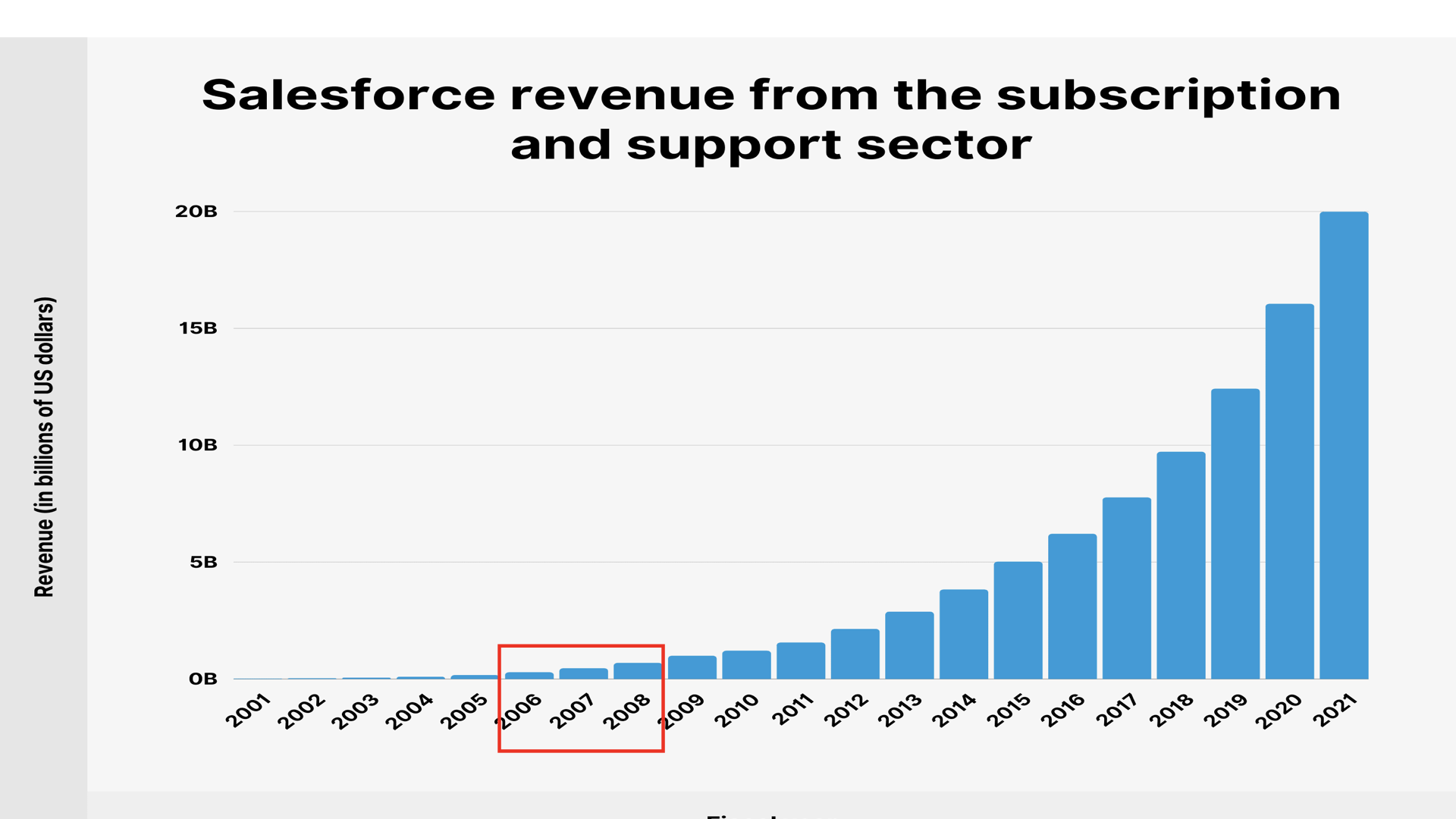
  4. Salesforce (CRM) was early with enterprise SaaS in 1999 along with Google and Amazon (consumer SaaS), the enterprise SaaS business inflection happened around circa 2007 i.e. the knee of the curve was 2007 – a 7-8 year lag behind consumer SaaS. (Salesforce revenue as a proxy).
A significant portion of the $800B of VC investments were funding CACC (Cost of Customer Acquisition). While I don’t have the actual percentage spent on CACC, but I would hazard a guess it would have been >30% maybe as high as 50% for many companies.

Assuming conservative 20%, that is $100B of venture capital going into CACC. And perhaps >$500B of cloud spend (COGS) with AWS, GCP and Azure during the same years. The total revenue of AWS, GCP and Azure between 2007 and 2022 is $1.4 trillion.

Hindsight is 20/20 – but projecting forward consumer AI and enterprise AI are going to be bigger – but the big shift is now from cost of customer acquisition (CACC) to Cost. of Compute (CoC) and the time collapse between Consumer AI and Enterprise AI. Lets look at both perhaps speculate or project forward.

  1. Cost of Compute (CoC)

A significant portion of VC and Corporate investments in the past 9 months is for cost of compute for largely consumer AI companies. The winner (to-date) in this round is Nvidia like SUNW was in the last round until 2003. Back in 2001, Internet was run by Sun boxes until the Open source, Linux and distributed systems became the new infrastructure stack.

As Elad Gil points out on twitter “At this point LPs in venture funds should just wire money direct to NVIDIA & skip the LP->VC->Startup->NVIDIA step”. Not so fast – the fish was falling into the boat back in 2001 at Sun and soon after it had to go fishing. More on this later.

And then there is Martin’s tweet – “If a company is going to train a $5B model, wouldn’t it make sense to use 5% of that to build a custom ASIC for that model? The benefits are certain to dwarf the 5% investment. At these scales, even ASIC design costs become marginal“. 5%. of $10B – enough for a new systems company to be built either from within the traitorous 8 or via a VC / Corporate investment. (more on this in a future blog).

The wake of the SaaS tsunami (since 2001) left us with AWS as the winner and leaving behind big SMP OEMs like SUNW, SGI, DEC, IBM). 20 years later the traditional Enterprise is served by 3 OEMs (CSCO, Dell, HPE) and 2+ enterprise software companies (Oracle, SAP and a distant third in IBM). Now they (the traditional enterprise infrastructure companies – both hardware and software) face a new tsunami with AI. A multi-trillion COGS spend is ahead of us and as we see new cloud investments (Coreweave, LambdaLabs) as well as AI+SaaS companies (the list above), potentially becoming the new AWS or GCP as they grow. Nvidia is spreading its new found shareholder capital to blanket this space. The silicon guys have woken up as they control the other end of the IP/value chain in a cloud stack. Given $10B+ of venture and corporate $s have gone to spend CoC in the past 7 months, it makes sense to fund startups that addresses CoC and challenge the incumbents? Seems like time is now – AWS from a perception has gone from #1 to #3 player in AI compute overnight, with Nvidia and (and perhaps its compatriots) thinking of how to enter this space.

AI unlike the past two decades of SaaS wants to be everywhere. In the cloud, on-prem, in-between, edge etc etc.

2. Enterprise AI

It took 7 years between 2000 and 2007 and >$10+B investments to transform the Enterprise SaaS with a new set of players. Instead of 7 years, in 7 months, we move from Consumer AI to Enterprise AI at breakneck speed. With the acquisition of Neeva by Snowflake, and MosaicML by Databricks, the first set of rockets have been launched to take on traditional enterprise companies (SAP, Oracle, IBM).

Back in 2007, the winners for infrastructure were new cloud companies. This time the winners for new infrastructure is likely to include silicon players (e.g. Nvidia, Intel, AMD, AVGO) and potentially some losers. Unlike 2007, with AI, there is this issue of Data (sovereignty, privacy, security) and CoC. Enterprise SaaS (e.g. Salesforce) started with on-prem infrastructure but moved to the cloud eventually. But there is a real possibility of reverse migration (move closer to data) especially with AI. Snowflake is already positioning itself as the DATAI cloud.

What is becoming a possibility is for the first time in perhaps 40-50 years, the incumbent enterprise software infrastructure companies (SAP and Oracle) are going to be challenged by Databricks and Snowflake. I say respectively because SAP is to Databricks and Oracle if to Snowflake follow Jerry Chen’s framework ( systems of intelligence and systems of record ) and it applies here once more.
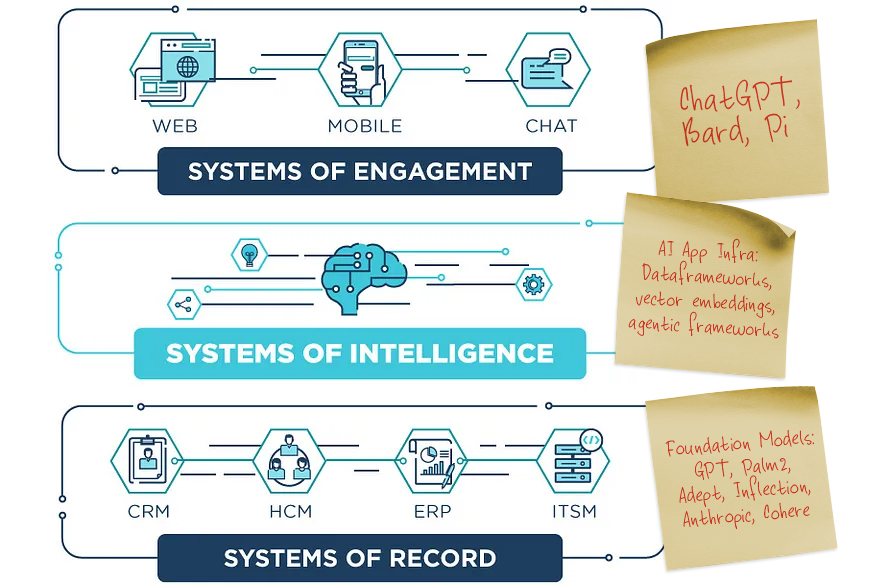
The systems of engagement are the new Chat Bots like ChatGPT and Bard. In the 1990s client server era – SAP took pole position in the App Tier (“Systems of Intelligence”) while Oracle powered the enterprises (“Systems of Record”) with Sun, HP and IBM being the infrastructure providers. I had a front row seat between 1991 and 2001 (Sun, SPARC etc) in both being enablers for SAP and Oracle via SMP platforms and built the multi-core/threaded processors to match with the emerging AppTier built with Java as the programming layer to take advantage of the thread parallelism from the silicon world.

With onset of AI, the agility and pace with which Databricks and Snowflake are Co-opting AI (both are in the cloud today) can challenge the traditional Enterprise duo (SAP and Oracle). While they both think they are competing, they are actually offering different value to the enterprises and over time they will overlap, but not today. The bigger opportunity for both is not to compete with each other but use the new tool in the quiver (“GenAI”) to upend SAP and Oracle with sheer velocity of execution, engagement value (SQL vs natural language. Both have to address data sovereignty if they want to take their fight to the SAP and Oracle world. Addressing that means like enterprise SaaS jumped to the cloud back in 2007, enterprise AI ha to extend from the cloud to be closer to the customer.

The success of Snowflake and Databricks despite competing and layering on top of current cloud infrastructure is proof point that they can compete against well capitalized and tooled companies (AWS – Redshift/EMR and Google – Spanner/BigQuery….) that if they chose to extend their offerings to on-prem enterprises , they can win if they can address the data problem i.e. they need to jump from current cloud to emerging new cloud offerings. They can enable and consume new infrastructure players who can solve or address the data proximity issue.

Given the scale of COGS spend in the cloud for $1.4 Trillion, there is a atleast a $1Trillion of spend ahead of us in Enterprise AI away from the big three (AWS, GCP, Azure) in the next 15 years potentially led by the new duo of Databricks and Snowflake. On-prem Enterprise AI – which will continue to thrive and could well seed the new infrastructure players.

Lets revisit this in 3 years if new infrastructure providers emerge addressing CoC in new and differentiated ways.

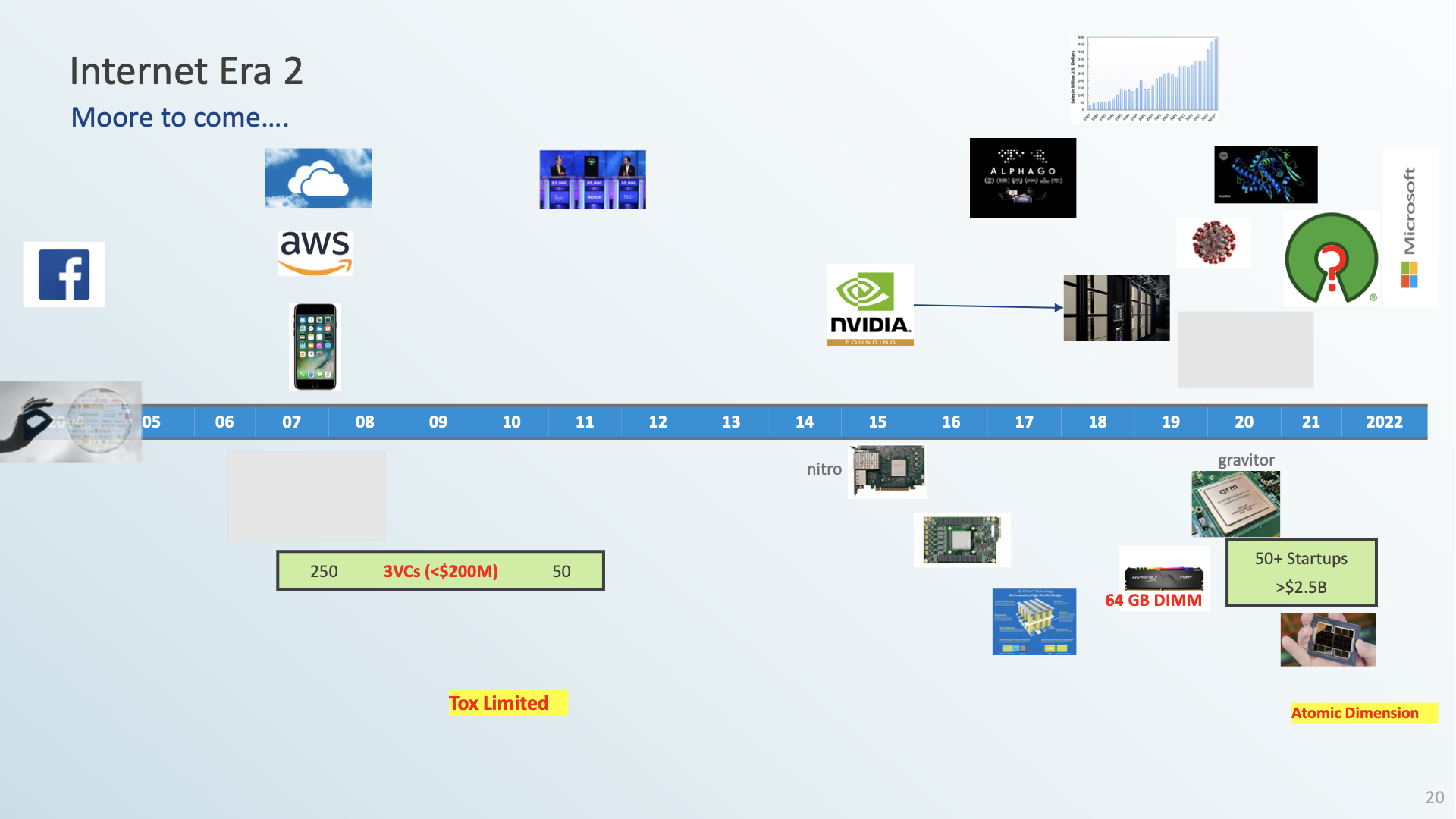
Many (core) Moore (Part III computing Epoch)

Back to the past – This is part III of four part story of the computing epochs as punctuated by Moore’s law in which Intel had its imprint for obvious reasons.

This is the 2003-2020 Era, in which multi-core, Open source, Virtualization, cloud infrastructure, social networks all blossomed…The onset of it was the end of MHz computing (Pentium IV) to multi-core and throughput computing.

It was also the beginning of my end in semiconductors for a brief period (20 years) until I decided its time to get back in the 2020s…That was punctuated by the first multi-core CPUs (mainstream) that Sun enabled – famously known as Niagara family and of-course the lesser know is UltraSPARC IIe which has an interesting contrast to Intel’s Banias (back to Pentium).

Some would call it Web2 era or Internet 2 era…The dot-com bubble which blew a number of companies in the prior era (OEM era), paved the way for new companies to emerge, thrive and establish the new stack. Notably at the infrastructure level, Moore was well ahead with first multi-core CPUs enabling virtualization and accelerated the decline of other processor companies (SPARC, MIPS), system OEMs as the market shifted from buying capital gear to cloud and opex.

Semiconductors investments started to go out of fashion as Intel dominated and other fabs (TI, National, Cypress, Philips, ST and many more withered) leaving Intel and TSMC with an also-ran Global foundries. In the same period, architectural consolidation around x86 happened along with Linux, ARM emerged as the alternative for. a new platform (mobile) via Apple. Looking back it was the value shifting from vertical integration (fab + processors) to SoC and thus IP (ARM) became dominant despite many attempts by processor companies to get into mobile.

Convergent to the emergence of iPhone/Apple/ARM, was AWS EC2 and S3 and thus the beginning of cloud with Opex as the new buying pattern instead of capex. This had significant implication as a decade later that very shift to commodity servers and opex comes full circle via Graviton and TPU with the cloud providers going vertical and investing in silicon. Intel’s lead on technology enabled x86 to dominate and when that lead in technology both slowed thanks to Moore’s law and TSMC, the shift towards vertical integration by the new system designers (Amazon, Google, Azure).

Simultaneously, emergence of ML as an emerging and significant workload that demanded new silicon types (GPU/TPU/MPU/DPU/xPU) and programming middleware (TensorFlow and PyTorch) broke the shackles from Unix/C/Linux to new frameworks and new hardware and software stack at the system level.

Nvidia happened to be at the right time at the right place (one can debate if GPU is the right architectural design), but certainly the new category or the tea leaves for the new system which is a CPU + xPU seeds were sown by mid 2010s….

All of the shift towards hyper scale distributed systems was fueled by Opensource. Some say that Amazon made all the money by reselling open source compute cycles. Quite true. Open source emerged and blossomed with the cloud and eventually the cloud would go vertical and raises the question – Is open source a viable investment strategy especially for infrastructure. The death of Sun microsystems was led by open source and. the purchase of RedHat by IBM formed the bookends of Open Source as the dominant investment thesis by the venture community. While open source is still viable and continues to thrive, it’s not front and center as a disruptor or primary investment thesis by end of this era as many more SaaS applications took the oxygen.

We started with 130nm 10 layers of metal with Intel taking the lead over TI and IBM and ended with 10nm from TSMC taking. the lead over Intel. How did that happen? Volumes have been written on Intel’s mis-steps, but clearly the investment into 3DXpoint and trying to innovate or bet with new materials and new devices to bridge the memory gap did not materialize and distracted. Good idea and important technology gap need, but picking the wrong material stack distracted.

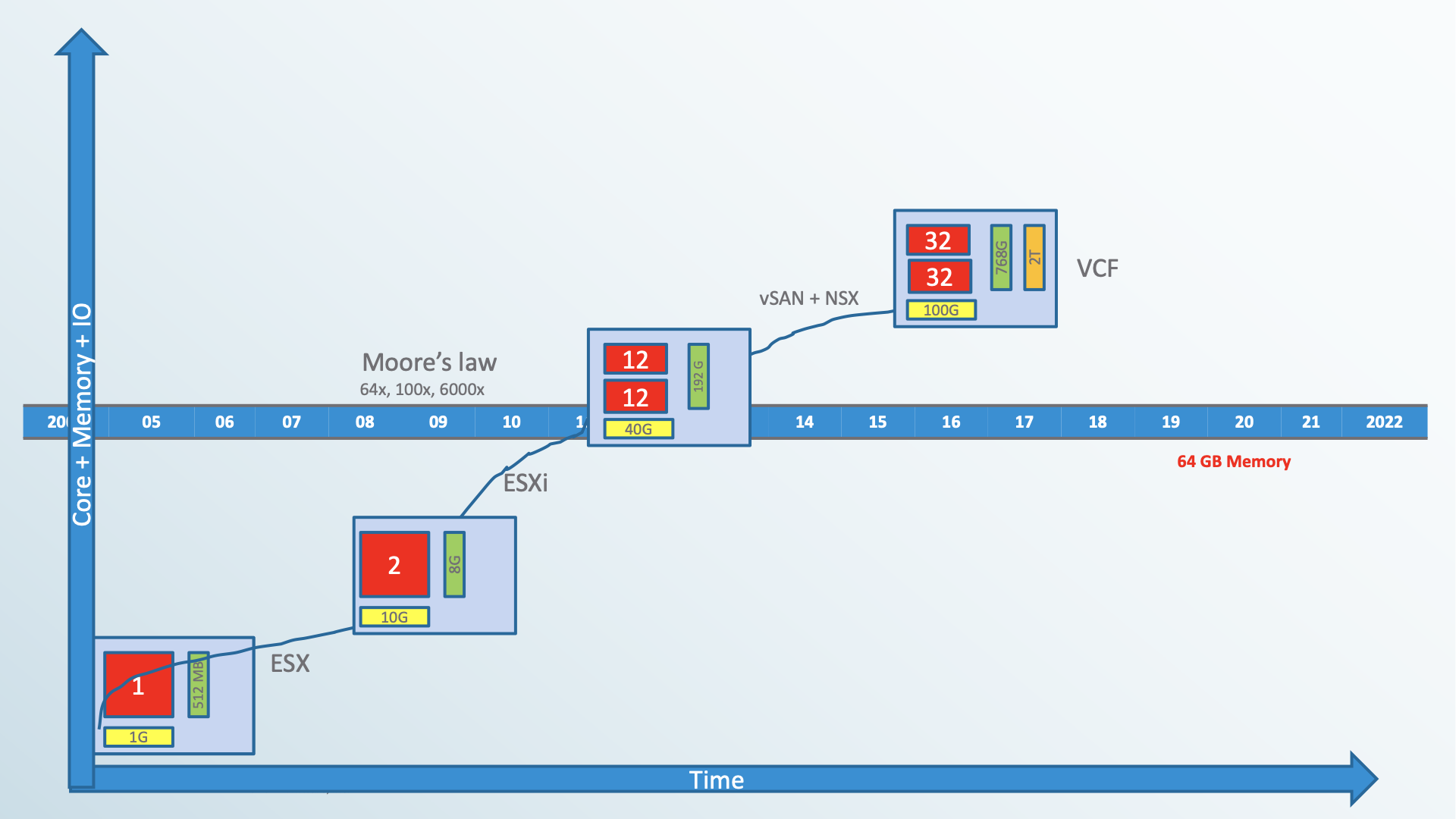
The companies that emerged and changed the computing landscape were VMware, Open Source (many), Facebook, Apple (Mobile), China (as a geography ). The symbiotic relationship between VMware and Intel is best depicted in the chart below.

Single core to dual socket multi-core evolution…

On networking front The transition from 10Gbps to 100Gbps (10x) over the past decade is one of the biggest transformation of networking adoption of custom silicon design principles.

Above chart shows the flattening of the OEM business while the cloud made the pie larger. OEMs consolidated around big 6 (Dell, HPE, Cisco, Lenovo, NetApp, Arista) and rest withered.

GPU/xPU emerged as a category and along with resurgence in semiconductor investments (50+ startups with $2.5+B of venture dollars). Generalization of xPU with a dual heterogenous socket (CPU + xPU) is becoming the new building blocks for a system, thanks to CXL as well. The associated evolution and implications for the software layer was discussed here.

We conclude this era with the shift from 3-tier enterprise (‘modern mainframe’) stack that was serviced by OEMs to distrbuted systems as implemented by the cloud providers where use case (e-commerce, search, social) drove the system design whereas technology (Unix/C/RISC) drove the infrastructure design in the prior era (a note on that is coming…)

In summary – Moore’s law enabled multi-core, virtualization, distributed systems, but its slowdown of growth opened the gates for new systems innovation and thus new companies and new stack including significant headwinds for Intel.

Lets revisit some of the famous laws by famous people…

  1. Original Moore’s law – (cost, density)

Bill Joy’s change it to Performance Scaling. Certainly slowing down and shift in performance moved to throughput over latency. Needs update for ML/AI era, as it demands both latency and throughput.

2.Metcalfe’s Law – Still around. See the networking section.

3.Wrights Law (demand and volume) – https://ark-invest.com/articles/analyst-research/wrights-law-2/ – this predates moore’s law and now applies to many more domains – battery, biotech, solar etc…

4.Elon’s law – (A new one…) – Optimal alignment of atoms and how close to that is your error. We are approaching that.

5.Dennard Scaling – Power limits are being hit. Liquid cooling is coming down the cost curve rapidly.

Open Systems to Open Source to Open Cloud.

“I’m all for sharing, but I recognize the truly great things may not come from that environment.” – Bill Joy (Sun Founder, BSD Unix hacker) commenting on opensource back in 2010.

In March at Google Next’17, Google officially called their cloud offering as ‘Open Cloud’. That prompted me to pen this note and reflect upon the history of Open (System, Source, Cloud) and what are the properties that make them successful.

A little know tidbit in history is that the early opensource effort of modern computing era (1980s to present) was perhaps Sun Microsystems. Back in 1982,  each shipment of the workstation was bundled with a tape of BSD – i.e. modern day version of open source distribution (BSD License?). In many ways much earlier to Linux, Open Source was initiated by Sun and in fact driven by Bill Joy. But Sun is associated with ‘Open Systems’ instead of Open Source. Had the AT&T lawyers not held Sun hostage, the trajectory of Open Source would be completely different i.e. Linux may look different. While Sun and Scott McNealy (open source)  tried to go back to its roots as an open source model, the 2nd attempt did not get rewarded with success (20 years later).

My view on success of any open source model requires the following 3 conditions to make it viable or perhaps as a sustainable, standalone business and distribution model.

  • Ubiquity: Everybody needs it i.e. its ubiquitous and large user base
  • Governance: Requires a ‘benevolent dictator’ to guide/shape and set the direction. Democracy is anarchy in this model.
  • Support: Well defined and  credible support model. Throwing over the wall will not work.

Back to Open Systems: Sun early in its life shifted to a marketing message of open systems rather effectively. Publish the APIs, interfaces and specs and compete on implementation. A powerful story telling that resonated with the customer base and to a large extent Sun was all about open systems. Sun used that to take on Apollo and effectively out market and outsell Apollo workstations. The Open Systems mantra was the biggest selling story for Sun through 1980s and 1990s.

In parallel around 1985, Richard Stallman pushed free software and evolution of that model led to the origins of Open Source as a distribution before it became a business model, starting with Linus and thus Linux.  Its ironic that 15+ years after the initial sale of Open systems, Open source via Linux came to impact Sun’s Unix (Solaris).

With Linux – The Open Source era was born (perhaps around 1994 with the first full release of Linux). A number of companies have been formed, notably RedHat that exploited and by far the largest and longest viable standalone open source company as well.


Slide1

The open systems in the modern era  perhaps began with Sun in 1982 and perhaps continued for 20 odd years with Open Source becoming a distribution and business model between 1995 and 2015 but will continue for another decade. 20 years later, we see the emergence of ‘open cloud’ or at-least the marketing term from Google.

In the past 20 years of the existence of Open Source, it has followed the classical bell curve of interest, adoption, hype, exuberance, disillusionment and beginning of decline. There is no hard data to assert Open Source is in decline, but its obvious based on simple analyses that with the emergence of the cloud (AWS, Azure and  Google), the consumption model of Open Source infrastructure software has changed. The big three in cloud have effectively killed the model as the consumption and distribution model of infrastructure technologies is rapidly changing. There are few open source products that are in vogue today that has reasonable traction, but struggling to find a viable standalone business model are elastic , SPARK (Data Bricks), Open Stack (Mirantis, SUSE, RHAT), Cassandra (Data Stax) ,  amongst others. Success requires all three conditions- Ubiquity, Governance and Support.

The Open Source model for infrastructure is effectively in decline when you talk to the venture community. While that was THE model until perhaps 2016, Open Source has been the ‘in thing’, the decline is accelerating with the emergence of public cloud consumption model.

Quoting Bill (circa 2010) – says a lot about the viability of open source model – “The Open Source theorem says that if you give away source code, innovation will occur. Certainly, Unix was done this way. With Netscape and Linux we’ve seen this phenomenon become even bigger. However, the corollary states that the innovation will occur elsewhere. No matter how many people you hire. So the only way to get close to the state of the art is to give the people who are going to be doing the innovative things the means to do it. That’s why we had built-in source code with Unix. Open source is tapping the energy that’s out there”.  The smart people now work at one of the big three (AWS, Azure and Google) and that is adding to the problems for both innovation and consumption of open source.

That brings to Open Cloud – what is it? While  Google announced they are the open cloud – what does that mean? Does that mean Google is going to open source all the technologies it uses in its cloud? Does that mean its going to expose the APIs and enable one to move any application from GCP to AWS or Azure seamlessly i.e .compete on the implementation? It certainly has done a few things. Open Sourced Kubernetes. It has opened up Tensor flow (ML framework). But the term open cloud is not clear. Certainly the marketing message of ‘open cloud’ is out there. Like Yin and Yang, for every successful ‘closed’ platform, there has been a successful ‘open’ platform.  If there is an open cloud, what is a closed cloud. The what and who needs to be defined and clarified in the coming years. From Google we have seen a number of ideas and technologies that eventually has ended up as open source projects. From AWS we see a number of services becoming de-facto standard (much like the Open Systems thesis – S3 to name one).

Kubernetes is the most recent ubiquitous open source software that seems to be well supported. Its still missing the ‘benevolent dictator’ – personality like Bill Joy or Richard Stallman or Linus Torvalds to drive its direction. Perhaps its ‘Google’ not a single person?  Using  the same criteria above  – Open Stack has the challenge of missing that ‘benevolent dictator’. Extending beyond Kubernetes, it will be interesting to see the evolution and adoption of containers+kubernetes vs the evolution of new computing frameworks like Lamda (functions etc). Is it time to consider an ‘open’ version of Lambda.

Regardless of all of these framework and API debates and open vs closed –  one observation:

Is Open Cloud really ‘Open Data’ as Data is the new oil that drives the whole new category of computing in the cloud. Algorithms and APIs will eventually open up. But Data can remain ‘closed’ and that remains a key value especially in the emerging ML/DL space.

Time will tell…..

On Oct 28th, IBM announced acquisition of RedHat. This marks the end of open source as we know today. Open Source will thrive, but not in the form of a large standalone business.

Time will tell…

Platformonomics

The Snark Must Flow!!!

wrong tool

You are finite. Zathras is finite. This is wrong tool.

----- Thinking Path -------

"knowledge speaks but wisdom listens" Jimi Hendrix.

The Daily Post

The Art and Craft of Blogging

WordPress.com News

The latest news on WordPress.com and the WordPress community.